
Flight payments account for a significant share of revenue activity for many online travel agents. Yet today’s processes are fragmented and under-automated, resulting in costs, delays, and reconciliation risks.
To understand how travel businesses actually manage flight payments today, and where they want to improve, Pax2Pay surveyed 200 UK-based travel organisations – 167 OTAs and 33 other travel agents, including tour operators, corporate travel managers, and accommodation providers. The research was designed with Adience, a B2B market research agency, and fieldwork ran in August 2025 via 20-minute telephone interviews.
Here’s what we found.
Managing Flight Payments Today
Flight payments make up a larger percentage of overall business for OTAs compared with other travel agents. Most OTAs say more than a quarter of their business involves online flight bookings – 40% put it at 51-75%, and a further 20% at 76-100%. Non-OTAs are a different story: only 3% said 76% or more of their business involved online flight bookings.
Scale drives supplier numbers, transaction volumes, and payment system complexity. Organisations with more than 50 staff are far more likely to pay 11 or more suppliers in a typical month, while the smallest players (one to 10 employees) are more likely to pay five or fewer. The same pattern holds for transaction volume – bigger organisations process more transactions. As size increases, so does the number of suppliers, transaction volumes, and the complexity of payment systems.
Organisations with higher transaction volumes also tend to have larger teams for processing and reconciling flight payments. Businesses handling £50-£100 million a year are more likely to have 11 or more people involved; those under £50 million typically rely on teams of five or fewer.
Paying for Flights Today
Flight payments are most commonly made via BSP/ARC settlement systems to airlines, GDS, and consolidators, using processes that are neither fully manual nor fully automated. Non-OTAs (39%) are less likely than OTAs (66%) to pay via GDS.
At 81%, BSP/ARC settlement and GDS-linked billing are the most commonly used payment methods among all respondents. Corporate credit or debit cards follow at 66%, virtual cards at 56%. Payment via provider platforms sits at 37%, and bank transfer at 33% – the least common of the methods asked about.
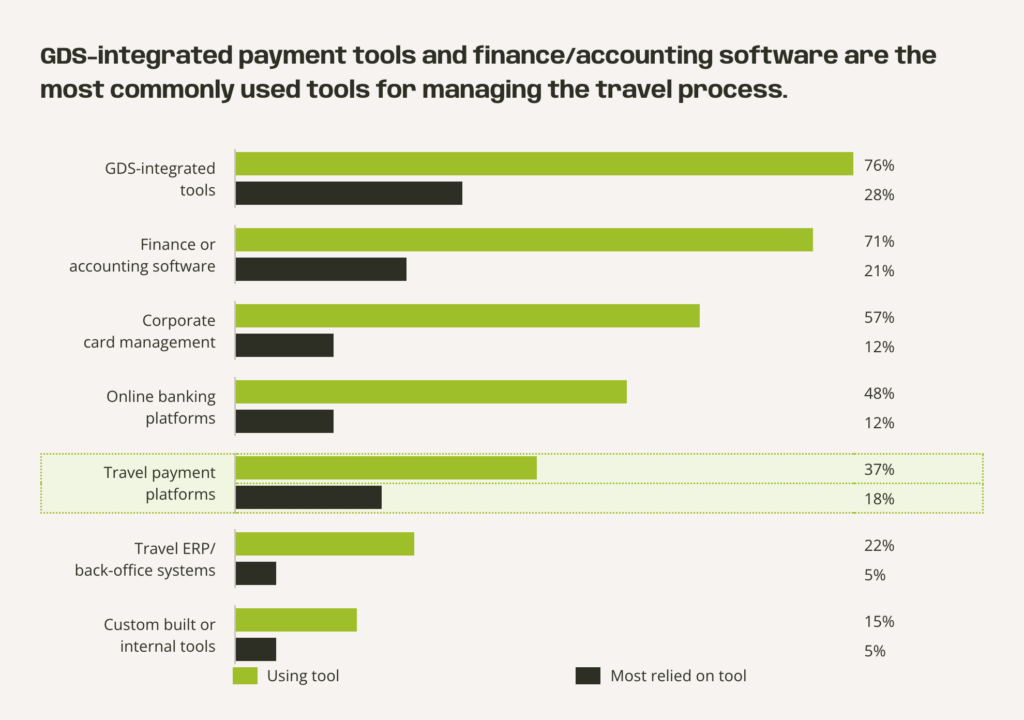
GDS-integrated tools are the most widely used overall: 76% of respondents use them, and 28% rely on them most. Finance or accounting software follows at 71% used / 12% relied on most. Travel payment platforms specifically are used by just 37% – but of those who do use one, half say it’s the tool they rely on most.
When it comes to travel payment platforms, WEX, AirPlus, and Pax2Pay are the top three. Together, these three pack leaders account for almost three-quarters (74%) of the market.
Six per cent of the organisations in our study still have fully manual flight payment processes. However, we also found that just 16% say they are fully automated and integrated. With 42% describing their business as “semi-automated” and 37% as “mostly automated,” the current status quo is that most companies are somewhere in between.
Where payment platforms help:
- Unify BSP/ARC and GDS-linked flows
- Reduce bank transfers
- Provide one location for booking, payment, and reconciliation
Addressing Payment Pain Points
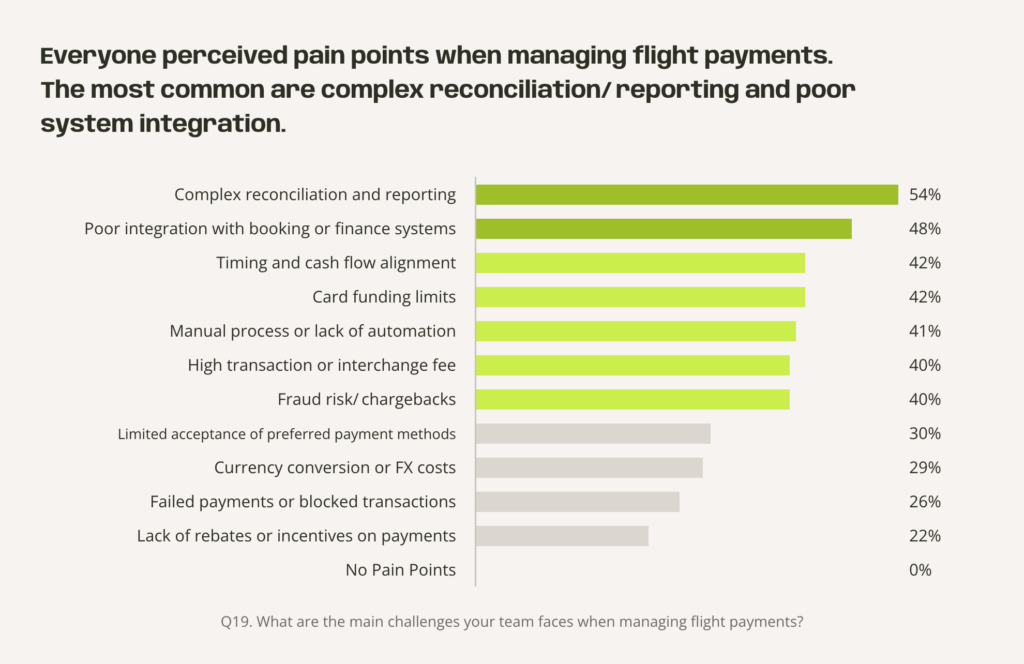
If reconciliation complexity, poor system integration, and inefficiency are familiar pain points in your organisation, rest assured – these are industry-wide hurdles when managing flight payments.
The most common challenges are complex reconciliation and reporting (54%) and poor integration with booking or finance systems (48%), followed by timing and cash flow alignment (42%), card funding limits (42%), and manual process or lack of automation (41%). In fact, 85% of travel companies surveyed reported experiencing three or more of these challenges – so it’s not surprising that many OTAs are changing their tools and processes to address them.
Almost two-thirds (64%) of the OTAs we consulted agreed that these pain points have at least a moderate effect on operational efficiency and profitability. 16% described the impact as “significant,” 48% said “moderate,” and 32% called it “minor.”
The top eight pain points that prompt organisations to consider switching from a flight payment or travel expense provider:
- Poor customer support or service
- Lack of integration with other systems
- Business growth or a change in payment needs
- Too many manual steps/not automated enough
- Limited payment options or flexibility
- Poor reporting or reconciliation functionality
- Compliance or audit challenges
- High costs (fees, FX charges)
Organisations are hungry to simplify and accelerate their current processes with automation. Asked what one thing they’d improve about how they pay flight suppliers, the most frequently mentioned answer was simplifying or automating processes, followed by improving efficiency and reducing delays, greater flexibility in payment options, better visibility and reporting, and greater security.
68% of respondents had changed or adapted their payment methods within the last 12 months to address these pain points, particularly the lack of automation. Of those, 24% pointed to automation/digitalisation/efficiency specifically, 16% to improved security, and 16% to card-based payments.
To improve and simplify payment processes, many respondents have already begun using embedded B2B wallets, virtual cards, real-time payments, and automation/smart reconciliation tools:
- 51% have adopted embedded B2B wallets or virtual cards
- 46% have adopted real-time payments
- 45% have turned to automation/smart reconciliation tools
- 36% use multi-currency payment accounts
- 16% use dynamic FX or currency routing
- 7% use stablecoin or blockchain-based payments
The Future: Faster, Safer, and More Transparent
In the future, OTAs anticipate faster, safer, and more transparent payments powered by automation, digitalisation, and centralisation.
Fraud protection/security, cost savings, and mobile/tablet applications are the top three motivations to adopt a new payment platform – though the top ten reasons all ranked closely together, showing there are numerous reasons to invest:
- Fraud protection and payment security features (55%)
- Cost savings (54%)
- Mobile or tablet application (52%)
- Automation/reduced manual processing (49%)
- Ease of use (48%)
- Faster reconciliation and reporting (48%)
- Integration with existing system (47%)
- Flexibility in payment options (47%)
- Real-time tracking or dashboards (47%)
- Better supplier acceptance/coverage (44%)
With over half saying a mobile/tablet application would influence their decision, we asked how mobile access could improve their ability to manage flight payments. Booking, payment processing, and payment tracking were the most frequently mentioned areas – respondents pointed to checking payment status in real time, approving payments while on the move, and booking urgent flights without waiting long for approvals.
Integrated systems are especially appealing. Integrations for cash flow management (59%), reconciliation/financial reporting (56%), and user permissions, approval flows, and audit trails (53%) are particularly desirable in a single platform. 41% are actively exploring or piloting multi-currency payment accounts and automation/smart reconciliation tools, 36% are exploring dynamic FX or currency routing, and 29% are investigating embedded B2B wallets or virtual cards.
We found that smaller companies are least likely to consider investing in new flight payment technology. Among firms with one to 10 employees, 52% say they are very or quite unlikely to invest in the next 12-18 months, followed by 37% among companies with 11-25 staff. By contrast, intent rises with size: 54% of organisations with 100 or more employees say they are very or quite likely to invest, compared with 38% of the smallest firms.
Looking Ahead
Looking ahead to the next two to three years, travel companies expect increasing speed and convenience when managing flight payments (26% mentioned this). Digital wallets and alternative payment methods are expected to become more common (16%), and increased flexibility (15%), transparency (15%), and automation (14%) are anticipated to make things easier still. Improvements in data analytics and forecasting (14%) and security/fraud prevention (13%) are also predicted.
The Takeaway
Flight payments in UK travel are still mostly stuck in the middle – not manual, but not automated enough either. Reconciliation and system integration are the two pain points nearly everyone recognises, and the organisations most affected are, unsurprisingly, the ones growing fastest and processing the most volume.
The direction of travel is clear, even if the pace varies by company size: more automation, more real-time visibility, better mobile access, and platforms that unify booking, payment, and reconciliation in one place rather than stitching several systems together.
Pax2Pay is a payments platform built specifically for the travel industry, part of the Paxport Group. If you’d like to talk through how automation, multi-currency support, or API-driven payments could fit into your own operations, get in touch with us.